Could you understand someone speaking English 1,500 years ago? Probably not. The name of the language would be familiar, but much of its vocabulary, grammar and pronunciation would be astonishingly different. The story of English is not a story of one language remaining unchanged. It is the history of a language constantly meeting other languages.
The beginning: Britain after Rome
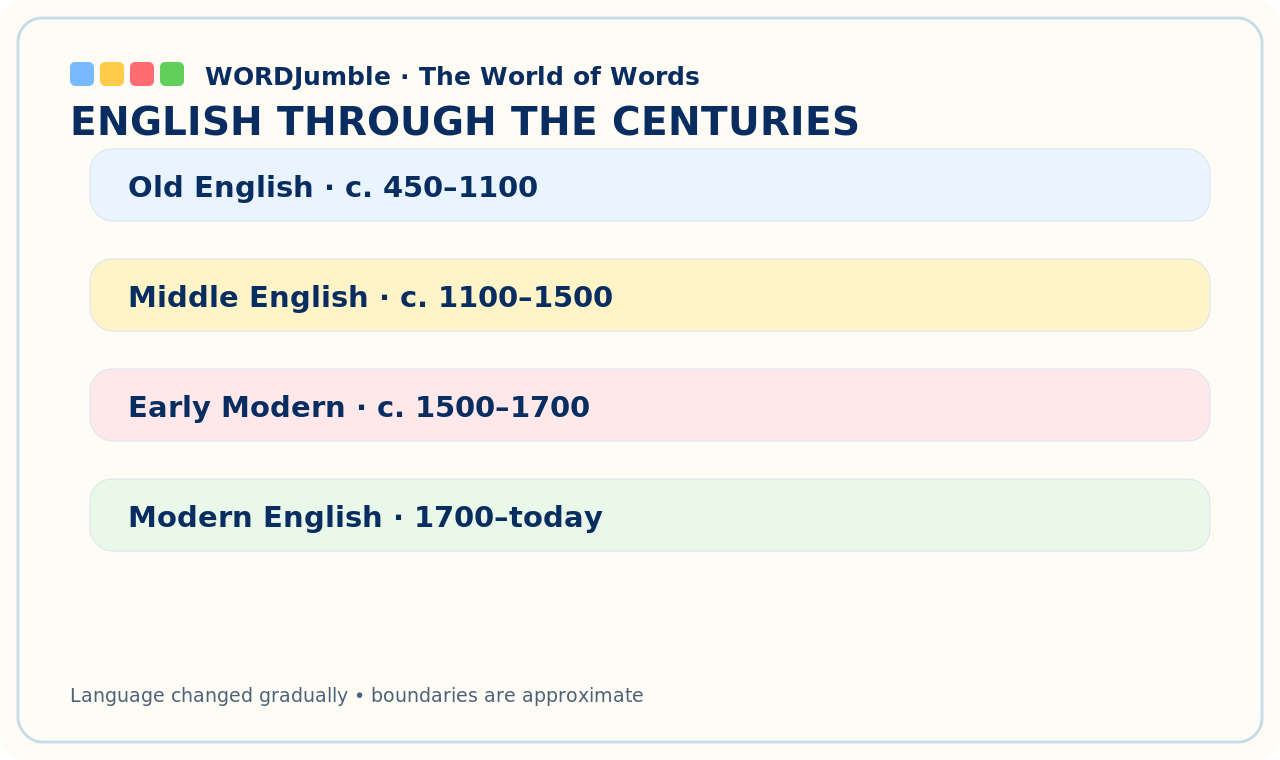
The English language began to emerge in Britain during the fifth century CE. People arriving from areas around what are now northern Germany, Denmark and nearby regions brought related West Germanic dialects. The groups traditionally called Angles, Saxons and Jutes figure prominently in accounts of this period, although migration and settlement were more complex than three neatly separated tribes.
The resulting dialects became what scholars call Old English. There was no one national language suddenly declared on a particular day. There were communities speaking related varieties that changed gradually as generations passed.
Old English did not sound like today’s English. It had more grammatical endings, different word forms and several dialect traditions. Yet familiar words such as house, water, bread and child have deep roots in this early Germanic layer.
A poem from another world
The epic Beowulf is a famous Old English work. Its opening words are difficult for an untrained modern reader, even though it belongs to the history of the same language. That is a useful reminder: languages change by tiny steps over time, until the accumulated differences become enormous.
Early English could be written in runes. Latin letters became increasingly important as Christian institutions and manuscript culture spread. Some old English letters, including thorn (þ) and eth (ð), represented sounds now commonly written with th.
Vikings and everyday words
From the late eighth century onward, Scandinavian activity and settlement brought speakers of Old Norse into close contact with English speakers. Their languages were related but not identical. Living and working together encouraged borrowing and change.
English words linked to Norse include sky and egg; the pronouns they, them and their also illustrate how deeply language contact can reach. Those are not rare literary decorations. They are ordinary tools of everyday speech.
1066: a political shock, a linguistic transformation
The Norman Conquest of 1066 brought rulers whose speech was connected with French. French gained prestige in many areas of law, administration and elite life, while English continued to be spoken widely. Across centuries of interaction, English absorbed many French words and developed into the varieties called Middle English.
This history helps explain why English sometimes offers two words for similar ideas: ask and question, for instance, have different historical origins and often different tones. English did not simply replace its Germanic vocabulary with French; the two layers came to coexist.
The author Geoffrey Chaucer wrote in Middle English in the late fourteenth century. His language is more recognizable than Beowulf’s, but its spelling and grammar still remind us that modern standard English was far from complete.
Printers, vowels and the modern language
William Caxton introduced printing to England in 1476. Printing did not instantly standardize English, but it helped written forms circulate more widely. At about the same broad period, English pronunciation was undergoing changes collectively known as the Great Vowel Shift. Many long vowel sounds moved, even while spelling practices were becoming more settled.
That history helps account for modern spelling puzzles: written English often preserves traces of older pronunciation. It is one reason a word can be familiar on paper yet surprising when spoken.
From the late fifteenth century onward, we speak of Early Modern English, associated with writers such as Shakespeare. Later scientific developments, global trade, empire, migration and new media brought yet more vocabulary and new varieties of English.
English did not stop changing
English today is spoken in many forms, including Indian English, Nigerian English, American English and British English. These are not merely imitations of one fixed original. Speakers adapt language to their own histories, communities and needs.
So when was English born? Around the fifth century is the best practical answer, but it was a gradual beginning, not an event with a birthday. English is about 1,500 years old in that historical sense, while its Germanic ancestors are older still.
A WordJumble question
Why are house and question so different in style? Part of the answer is history: house belongs to English’s Germanic inheritance, while question entered through French and Latin. A dictionary can show us definitions; word history shows us how the vocabulary arrived.