Picture a merchant preparing a shipment more than three thousand years ago. Goods need to be counted, names recorded and messages delivered. Imagine how useful a compact set of written signs would be—signs that could stand for the sounds in a word rather than requiring a different symbol for every thing. That is the extraordinary idea behind alphabetic writing.
Writing existed before alphabets
Writing was already well established in ancient Mesopotamia and Egypt before the earliest alphabetic inscriptions appeared. Cuneiform and Egyptian hieroglyphs could represent sounds as well as words and ideas. It would be misleading to call them merely picture writing, or to assume that all writing systems were steadily marching toward the alphabet. They solved different linguistic and practical problems in different ways.
The crucial alphabetic innovation was a comparatively small collection of signs used to represent the consonantal sounds of a language. The earliest alphabetic inscriptions known to scholars come from Egypt and the Sinai region, with dates in the early second millennium BCE often proposed. Their precise chronology and the identity of their makers remain debated.
A clever use of familiar signs
Many researchers think Semitic-speaking people adapted forms inspired by Egyptian signs and assigned them the sound at the beginning of a Semitic word. An ox-head sign, for example, is associated with the word aleph, meaning ox. This technique—using the initial sound of a word as the value of a sign—is called the acrophonic principle.
These early experiments are often discussed under names such as Proto-Sinaitic and Proto-Canaanite. They were not quite the neat A-to-Z alphabet on a classroom wall. Their letters chiefly represented consonants. The idea was powerful nonetheless: a limited set of signs could be reused to write many different words.
The Phoenicians spread the system
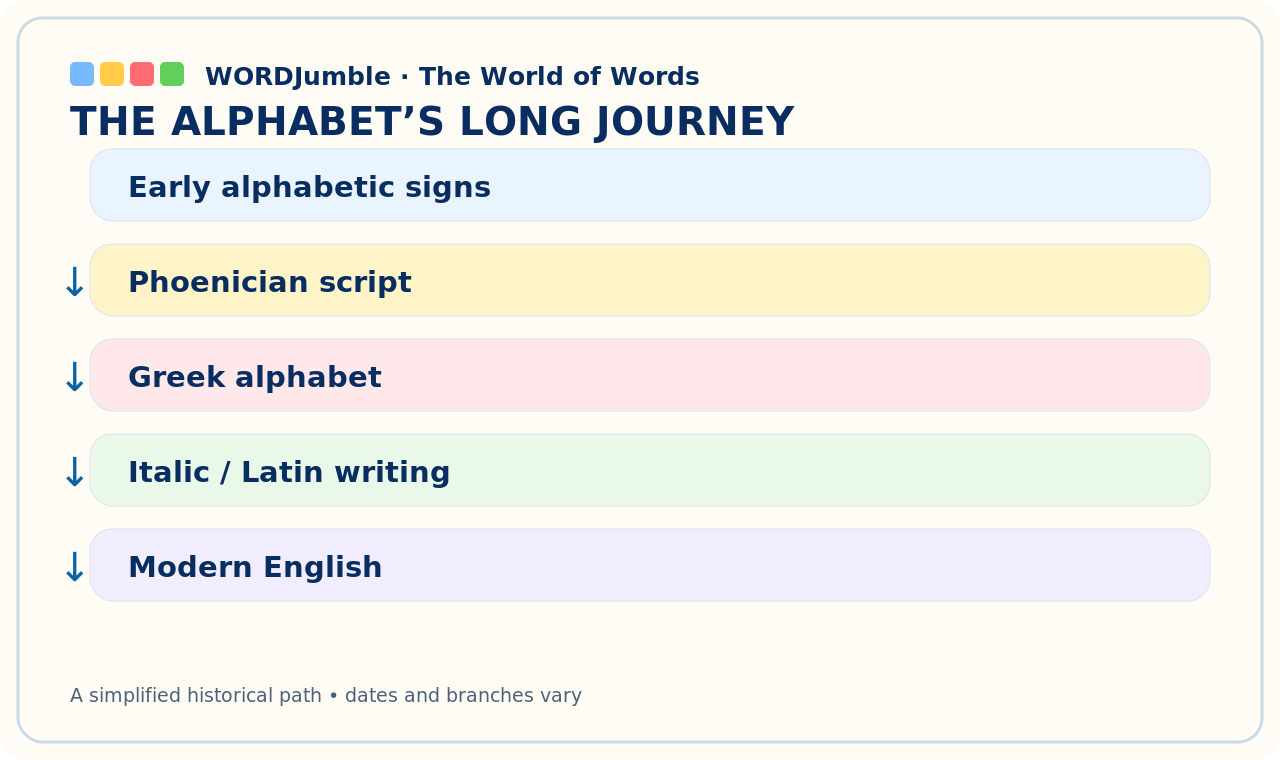
By the first millennium BCE, the Phoenicians of the eastern Mediterranean were using a well-established consonantal script of 22 signs. Their seafaring and trade networks helped carry it into contact with other communities. The Phoenicians did not invent writing, and they are not necessarily the first inventors of alphabetic signs. Their particular contribution was to develop and circulate a highly influential version.
Imagine the effect of a writing system that merchants in different ports could learn and adapt. A small inventory of signs could travel with traders, craftspeople and settlers. From this tradition came several branches of writing across the Mediterranean and Near East.
The Greeks did something different
When Greek speakers adapted a Phoenician-style script, they faced a problem: Greek required vowel distinctions that the inherited consonantal system did not mark in the same way. So they reused some signs to represent vowels. The result was an alphabet that regularly wrote both consonants and vowels, a major difference from its ancestor.
Greek alphabets were not all identical at first. Different regions used different shapes and local practices. One branch helped shape scripts used in ancient Italy, including the Etruscan tradition, and ultimately the Latin alphabet associated with Rome.
From Roman letters to English
The Romans spread Latin writing across much of Europe. English eventually adopted and adapted that script, though early English also used runes and medieval writers retained letters that do not appear in the modern 26-letter alphabet. The alphabet a child learns today is therefore an inheritance with many layers: Egyptian inspirations, Semitic sound values, Phoenician networks, Greek changes, Italian adaptations and centuries of English practice.
A small set of signs, a very large story
Was there a single person who first thought of representing language with alphabetic signs? We do not know. The surviving evidence is too fragmentary to name one. And “who invented the alphabet?” has more than one possible meaning: the first consonantal alphabet and the later consonant-and-vowel alphabet belong to different stages of history.
The remarkable truth is not that one inventor made all 26 letters. It is that successive communities found new uses for inherited signs. Today we use those letters for shopping lists, science, poetry, messages—and word puzzles. Every letter holds a little history, even when its ancient shape has disappeared.
A WordJumble question
The word ALPHABET comes ultimately from the names of the first two Greek letters. What are they? Alpha and beta. The name of the writing system itself is a clue to its past.