Imagine two people living long before the first cities, books or alphabets. One notices danger. Another needs help carrying food. They can point, call, gesture and react. At some point in the long history of our species, communication became language: a flexible system in which a community could express an extraordinary range of meanings.
But who invented the first word? That question has no known name, place or date attached to it.
Words are older than writing
The oldest surviving written records are only a few thousand years old. Human spoken language must be older, but speech leaves no marks in stone merely by being spoken. An archaeologist can uncover tools, bones, pigments and inscriptions. They cannot recover a conversation that vanished thousands of years ago.
The Smithsonian’s Human Origins Program puts this plainly: scientists are not sure when humans began talking, because spoken language does not fossilize. Researchers must instead work with indirect clues from anatomy, genetics, artifacts and patterns of human behaviour.
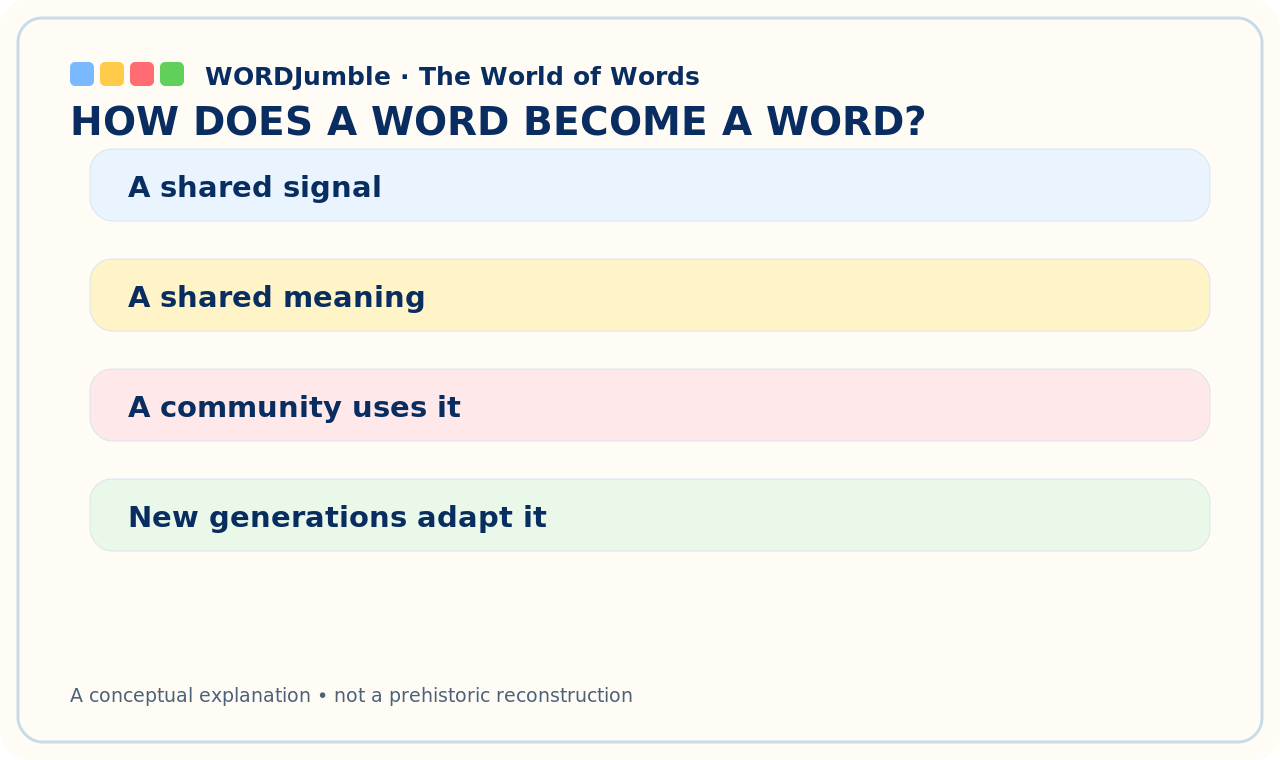
A sound becomes a word when people share its meaning
Suppose somebody makes a sound every time a dangerous animal appears. If other people recognize the signal and use it too, that community has a meaningful convention. But real language is far richer than a handful of warning cries. Humans can talk about yesterday, tomorrow, imaginary creatures, things that are absent and events that have never happened.
A word therefore is not merely a noise. In spoken languages it is part of a larger conventional system of meanings and grammatical patterns. And language is not limited to speech: signed languages are fully developed human languages as well.
A single person can invent a new expression, but a community determines whether it takes root. If no one else uses the expression, it may disappear. If others adopt it, it can become part of living language.
Why the earliest language is still a mystery
Scholars have proposed different explanations for language evolution. Some emphasize cooperative social life and the need to coordinate. Others emphasize gestures, vocal learning, symbolic thought or complex cultural behaviour. These possibilities are studied seriously, but no one explanation has become a proven account of the first words.
There is even disagreement about the timeline. Some evidence suggests roots of human language ability far back in prehistory, while researchers differ on when language became as flexible as the languages we know today. The available record does not let us identify a single date or a single “first speaker.”
Evidence of symbolic behaviour—including pigments and engraved objects—provides useful clues, but using symbols is not identical to proving that people spoke a language in a modern form. The distinction matters when we tell the story honestly.
Did humans begin by copying animal sounds?
One old suggestion was that words began as imitations of noises. Modern English does contain onomatopoeic words such as buzz and hiss. Yet different languages can represent the same animal sounds in strikingly different ways. Imitation cannot explain the full richness of syntax, abstract vocabulary and human communication.
Another possibility emphasizes gesture. People can coordinate through pointing and hand movements. Modern signed languages show that grammar and complex communication do not require speech sounds. But this observation does not prove that all spoken languages began with gestures. It is one piece of a much larger puzzle.
New words are still being born
Although the first word is lost to history, we can watch words enter a language today. Smartphone combines older words for a newer object. Email shortens electronic mail. Other words arrive through borrowing, slang, scientific naming, changes in meaning and playful creativity.
Not all candidates last. Some become everyday speech, while others fade quickly. Dictionaries document common usage; they do not magically grant every newly coined expression a future.
The bigger answer
The best answer to “who invented words?” is not the name of a prehistoric genius. Words grew through human social life, and their origins probably reflect a long evolutionary and cultural history. Scientists still debate the timing and mechanisms.
That uncertainty is not a weakness in the story. It is what makes the question fascinating. Every word we say today is part of a system that people learn from others and continually reshape. Language belongs to communities, and its oldest beginnings remain beyond our direct view.
A WordJumble question
Can a word exist before it appears in a dictionary? Of course. People speak, sign and write words long before lexicographers record them. Usage makes language; dictionaries try to describe it.