Why does the alphabet begin with A and end with Z? And who decided we needed exactly 26 letters? It is tempting to imagine a committee settling the matter. In reality, nobody designed the complete modern English alphabet from scratch. Its familiar order and size are historical accidents that proved remarkably durable.
The order is much older than English
Long before anyone spoke English, alphabetic traditions in the ancient Near East had a recognizable sequence of signs. Names such as aleph, beth, gimel and daleth were associated with the opening letters of the early Semitic alphabetic order. The Greeks adapted this tradition, giving us alpha, beta, gamma and delta.
Even our word alphabet comes from alpha and beta. English inherited letter order through a long chain of writing systems rather than inventing an ideal sequence for its own sounds.
That sequence was never perfectly frozen. Individual signs shifted position or disappeared in some traditions. But the broad conventional order endured because people learned it, copied it and built habits around it.
Why 26 is not a magic number
Modern English uses 26 letters, but the number is neither a universal requirement nor a one-letter-per-sound system. English contains more distinct speech sounds than there are letters, and combinations such as sh, ch and th show how spelling uses multiple signs to represent sounds.
The Romans used a Latin alphabet that was not identical to today’s English alphabet. Over time, distinctions between letter forms became standardized, and English ended up with its present set of 26.
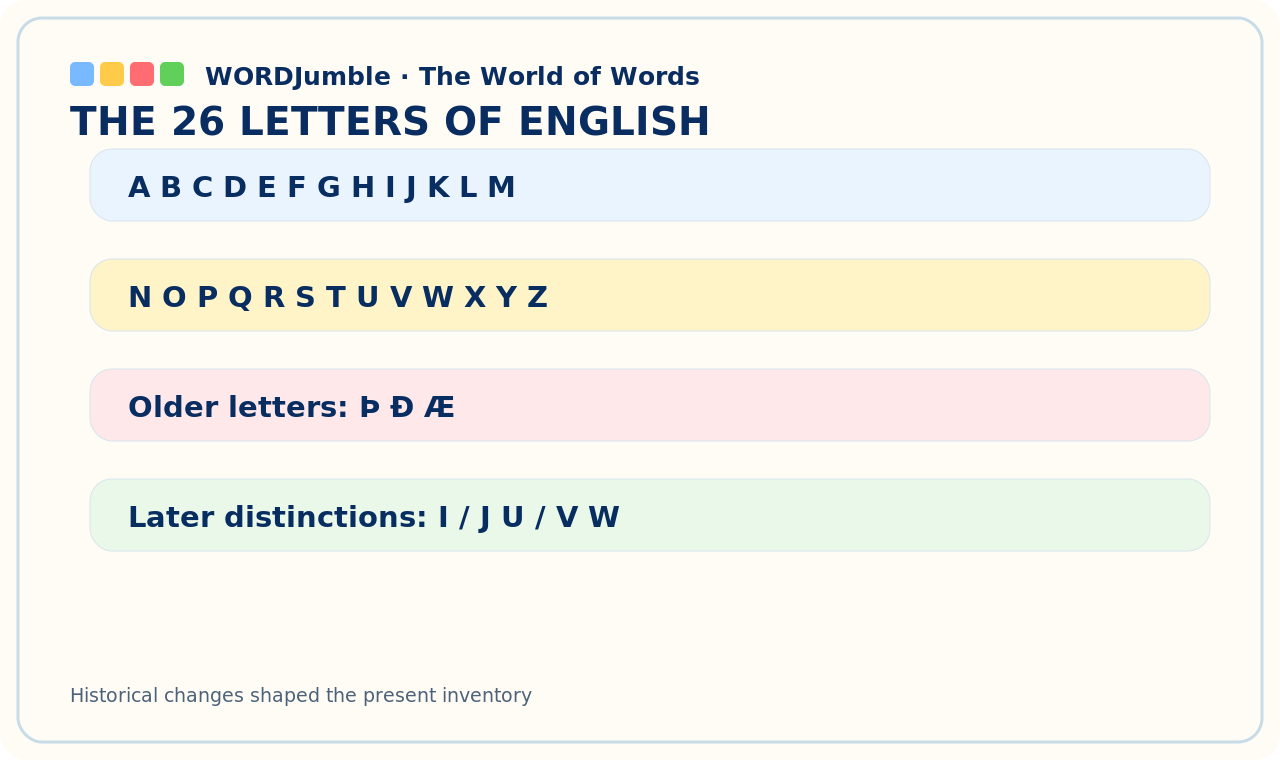
Where did J, U and W come from?
For a long time, letter forms that we now distinguish were treated together. I and J were historically connected, and U and V were likewise used as related shapes. Over centuries, writing and printing practices helped establish their separate functions.
W has a particularly revealing name. Its familiar form developed from a doubling of a letter form used to represent a w-like sound. Depending on the writing tradition, that shape can look like a double U or double V. The name double-u preserves one version of its history.
These distinctions were gradual. It would be inaccurate to say that one person simply invented J, U and W in a single year and added them to the alphabet overnight.
English once had letters we no longer use
Old English could be written with letters such as thorn (þ) and eth (ð), used for sounds now generally written th. Ash (æ) also had a place in Old English spelling. Many readers recognize these shapes only from historical texts or from other languages in which related letters remain in use.
Had English maintained some of those symbols as independent standard letters, the present alphabet might contain more than 26. Instead, conventions changed through manuscripts, foreign influence, printing and education.
The English alphabet therefore reflects both additions and losses. It was not simply a matter of starting with 23 letters and adding three more without any other changes.
Why not rearrange everything?
Alphabetical order is useful because it is shared. Dictionaries, indexes, directories and classrooms all depend on predictable sequencing. Reordering the letters could be done in theory, but it would require millions of people and countless systems to relearn a deeply established convention.
And even the alphabet song benefits from that continuity: children inherit a sequence with roots going back millennia, though they rarely realize it.
An unexpected twist: the letter G
Latin writing itself changed. The letter G developed as a modified form of C, and its place near the beginning of the Roman alphabet reflects a particular historical adjustment. The European Commission’s account of the 26-letter alphabet uses this example to show how much history is hidden in an apparently simple list.
A familiar tool with an unfamiliar past
There is no profound mathematical reason English must have exactly 26 letters. The answer lies in the alphabet it inherited, changes in writing conventions and centuries of standardization. Languages using other scripts manage perfectly well with different inventories of signs.
When you type A, B, C, you are participating in a convention older than English itself. Those letters are not merely shapes for spelling words: they are records of contact among different cultures, stretched across thousands of years.
A WordJumble question
Which three modern English letters were historically not always distinguished as independent letters in the Latin writing tradition? J, U and W. Their stories are a reminder that even an alphabet can evolve.